Case study
Conversational AI Assistant for Drilling Performance Optimization
Drilling engineers operate in a highly data-intensive environment, where performance optimization depends on quickly extracting insights from large, fragmented datasets. These datasets include structured sources (e.g., well KPIs, operational metrics) and unstructured sources (e.g., daily drilling reports). ID3 Software addressed this challenge by implementing a conversational AI assistant within the ID3 Benchmark analytics platform for a major global energy operator. The solution enables engineers to interact with data using natural language, significantly reducing the complexity and time required for analysis.
Summary
Drilling engineers operate in a highly data-intensive environment, where performance optimization depends on quickly extracting insights from large, fragmented datasets. These datasets include structured sources (e.g., well KPIs, operational metrics) and unstructured sources (e.g., daily drilling reports).
ID3 Software addressed this challenge by implementing a conversational AI assistant within the ID3 Benchmark analytics platform for a major global energy operator. The solution enables engineers to interact with data using natural language, significantly reducing the complexity and time required for analysis.
Problem Statement
Despite the availability of advanced analytics tools, several challenges persisted:
- Fragmented Data Access Engineers often need to gather data across multiple wells, systems, and interfaces.
- Manual Navigation & Reporting Even with multiwell analytics tools, users must navigate multiple dashboards to extract insights.
- Unstructured Data Complexity Daily drilling reports and logs require manual interpretation and are difficult to query.
- Technical Barriers Accessing and combining datasets frequently requires SQL expertise, limiting accessibility.
- Time-Consuming Analysis Consolidating and interpreting data delays decision-making in time-sensitive operations.
Solution
To address the challenges of fragmented data and manual analysis, the client leverages the conversational AI assistant built into our ID3 Benchmark software to streamline drilling performance analysis.
Instead of navigating multiple dashboards or relying on SQL expertise, drilling engineers can simply ask questions in natural language and receive immediate, data-driven answers. The assistant not only retrieves information from multiple datasets but also interprets results, enabling faster and more intuitive decision-making.
Behind the scenes, the system combines technologies such as LangGraph, LangChain, and large language models from OpenAI. User queries are automatically translated into SQL, executed across structured and semi-structured data sources, and returned as clear, contextualized insights. Built-in safeguards ensure accuracy, data security, and controlled access.
Usage Scenario: Benchmarking for New Well Planning
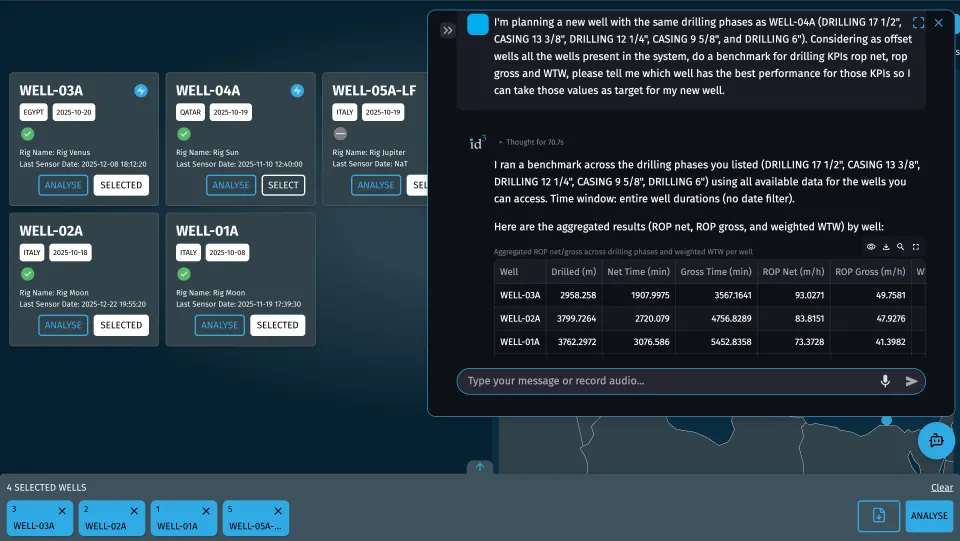
In a typical workflow, an engineer asked the ID3 AI Assistant: “I’m planning a new well with the same drilling phases as WELL-04A (DRILLING 17 1/2”, CASING 13 3/8”, DRILLING 12 1/4”, CASING 9 5/8”, and DRILLING 6”). Considering all wells in the system as offset wells, please perform a benchmark for the drilling KPIs: ROP net, ROP gross, and WTW. Tell me which well has the best performance for these KPIs so I can use those values as targets for my new well. “
Within moments, the assistant ran a benchmark across all relevant wells and drilling phases (17 1/2”, 12 1/4”, and 6”) and returned a clear summary of results. WELL-03A emerged as the top performer for average net ROP (93.03 m/h) and gross ROP (49.76 m/h), while WELL-02A had the best average WTW (13.56 minutes).
Beyond just reporting the numbers, the assistant provided a concise interpretation and guidance for follow-up analysis. It noted that the KPIs were aggregated across the selected phases and offered the option to break them down by individual phase or access stand-level data for statistical robustness.
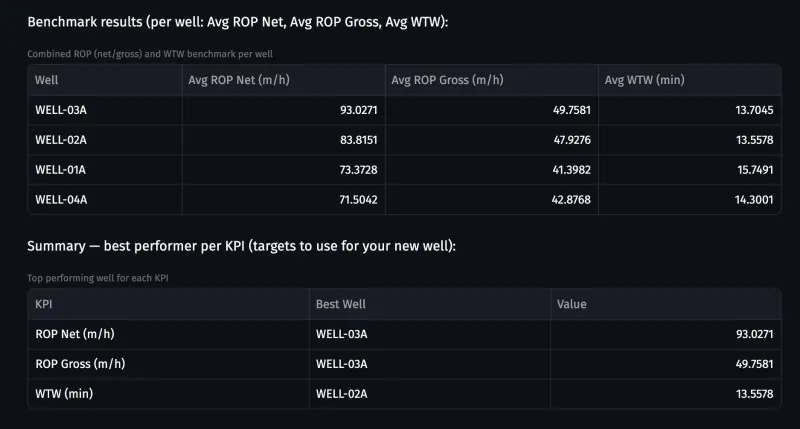
Fig. 1 AI Assistant Output Tables
This example highlights how the AI assistant not only simplifies complex multi-well benchmarking but also supports new well planning directly, helping engineers set specific performance targets based on existing wells and enabling faster, more precise, data-driven decision-making
Business Impact
By embedding the AI assistant within the ID3 Benchmark, ID3 provided the client with a significant improvement in efficiency and decision-making. Engineers no longer need to manually navigate multiple dashboards or assemble reports, dramatically reducing the time required to generate actionable insights.
The system also democratizes access to data. With natural-language queries, users without SQL expertise can perform advanced analyses, making critical information accessible to a wider range of team members. This instant access to insights allows for faster, more informed decisions, with KPIs interpreted in real time to support operational responsiveness.
Performance optimization has become more proactive. The assistant helps identify inefficiencies quickly, enhances benchmarking across wells, and supports continuous improvement initiatives, enabling teams to act on insights rather than simply reviewing them.
Strategic Value
More broadly, the solution represents a transformation in how industrial analytics are conducted. It shifts workflows from passive data access to interactive data engagement, from static dashboards to dynamic conversations, and from manual analysis to AI-augmented decision-making. Acting as a digital engineering copilot, the assistant enhances human expertise - empowering engineers to make smarter, faster, and more confident decisions.